|
RomRaider
Documentation
Community
Developers
|
| Author |
Message |
|
02rexwi
|
Post subject: Re: SPREADSHEET: GM IAT  Posted: Posted: Tue Feb 21, 2012 9:19 am |
|
 |
| Experienced |
Joined: Wed Jul 16, 2008 7:32 pm
Posts: 324
|
Thanks for the post! 
|
|
| Top |
|
 |
|
bcheck555
|
Post subject: Re: SPREADSHEET: GM IAT Posted: Tue Feb 21, 2012 10:53 pm |
|
|
| RomRaider Donator |
Joined: Thu Jan 29, 2009 11:16 am
Posts: 523
|
|
| Top |
|
|
|
eminehart
|
Post subject: Re: SPREADSHEET: GM IAT Posted: Mon Apr 23, 2012 6:12 pm |
|
|
| Experienced |
 |
Joined: Tue Feb 19, 2008 11:02 pm
Posts: 244
Location: Broomfield, Colorado
|
I am using the AEM IAT sensor, it should be the same sensor as the GM Open element sensor. I am tuning the car right now with Cobb's speed density and I thought that their recommended calibration for the sensor gave me values that were too high. generally 12-20 degrees above ambient during cruise and idle. Also before I would fire up the car at all, temps were already 10 degrees above ambient. This spreadsheet seemed to give me more realistic values. I started doing things from AEM's Resistance's value here. [url]http://www.aemelectronics.com/files/info/30-2010_2.pdf [/url] I made a quick and dirty spreadsheet based on AEM's data with adjustable Internal resistance. I basically did this by setting everything up in Celcius according to these temps and calculated the Voltage. using the above equation. and 1229 for the resistance. This is the resulting values in C. Code: 0.481617647 0.54806926 0.624154383 0.711494173 0.811464794 0.925066313 1.055840822 1.20210136 1.366055588 1.547752809 1.746956061 1.965432099 2.199179581 2.445968412 2.700224551 2.956434985 3.210541642 3.456417985 3.688647034 3.903070332 4.096456403 4.266881413 4.413924654 4.538039393 4.6406853 4.724105419 4.790808511 4.843331719 4.884100339 4.915312634
110 105 100 95 90 85 80 75 70 65 60 55 50 45 40 35 30 25 20 15 10 5 0 -5 -10 -15 -20 -25 -30 -35
I attached the quick and dirty spreadsheet below.
_________________
-Eric Minehart
2009 WRX Dom 3 on e85
2002 WRX VF30 on E85(SOLD)
eminehart@yahoo.com
www.torquedperformance.com
|
|
| Top |
|
|
|
Fearless
|
Post subject: Re: SPREADSHEET: GM IAT Posted: Mon Apr 23, 2012 6:59 pm |
|
|
| Experienced |
 |
Joined: Thu Apr 19, 2012 3:44 am
Posts: 385
|
Toyota/Denso stuff from the early 90s, at least, uses 2.7k (measured 2.685k) 1% MF bias resistors, and the curve looks like this, except the twist at the end, which was error for sure: 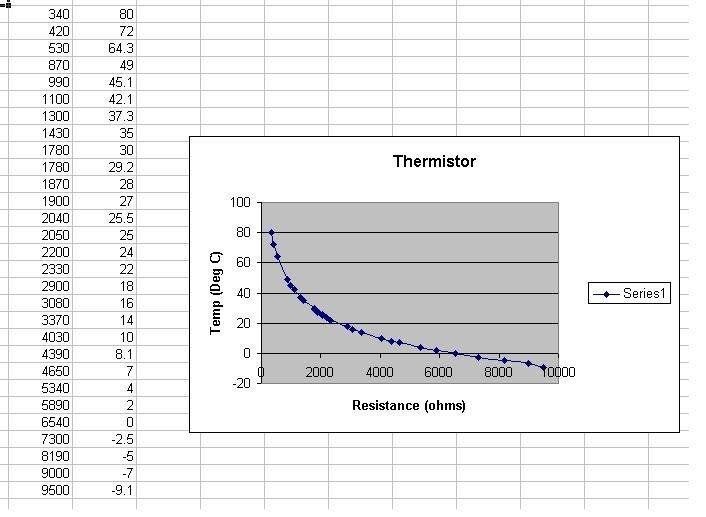 That's my data, I measured it myself years and years ago. The sensors themselves look like this (the green one): 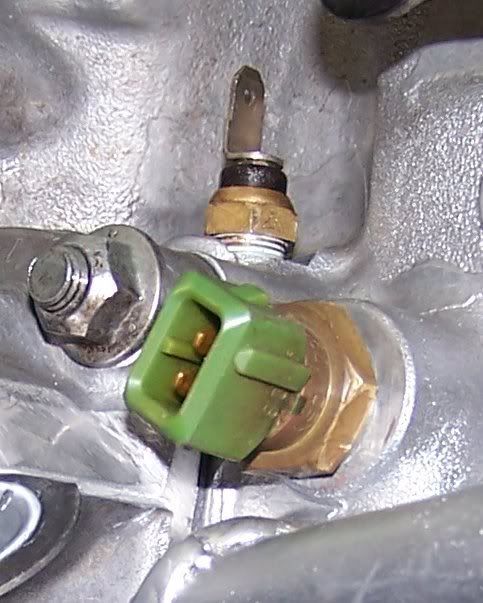 You can use any value bias vaguely near the centre of the curve, it just pushes the accurate area up and down, that's all. I provide preset calibrations of 2.0, 2.2, 2.4, 2.49(gm), 2.6 and 2.7k for the above, the gm and the standardish bosch sensor curves. If you want to be really accurate with your temperatures, then you need to measure your actual sensor and actual bias resistor and use a curve for the pair. The math to generate a temperature curve based on the voltage lookup for a given sensor curve is fairly straight forward, but not suitable for doing in real time. It uses three points of resistance and temperature, with the bias value, to give you a temperature for any voltage. It's googleable/duckduckgoable, but I can post it if you want. Fred.
_________________
The type of scooby that I most enjoy!
|
|
| Top |
|
|
|
mrf582
|
Post subject: Re: SPREADSHEET: GM IAT Posted: Fri Apr 27, 2012 3:17 pm |
|
|
| Senior Member |
Joined: Fri Feb 10, 2006 7:04 pm
Posts: 2661
Location: RIP
|
|
| Top |
|
|
|
Fearless
|
Post subject: Re: SPREADSHEET: GM IAT Posted: Fri Apr 27, 2012 3:25 pm |
|
|
| Experienced |
|
Joined: Thu Apr 19, 2012 3:44 am
Posts: 385
|
|
| Top |
|
|
|
mrf582
|
Post subject: Re: SPREADSHEET: GM IAT Posted: Wed May 02, 2012 10:38 am |
|
|
| Senior Member |
Joined: Fri Feb 10, 2006 7:04 pm
Posts: 2661
Location: RIP
|
|
| Top |
|
|
|
Fearless
|
Post subject: Re: SPREADSHEET: GM IAT Posted: Wed May 02, 2012 1:20 pm |
|
|
| Experienced |
|
Joined: Thu Apr 19, 2012 3:44 am
Posts: 385
|
|
| Top |
|
|
|
mrf582
|
Post subject: Re: SPREADSHEET: GM IAT Posted: Thu May 03, 2012 3:52 pm |
|
|
| Senior Member |
Joined: Fri Feb 10, 2006 7:04 pm
Posts: 2661
Location: RIP
|
|
| Top |
|
|
|
Fearless
|
Post subject: Re: SPREADSHEET: GM IAT Posted: Fri May 04, 2012 7:22 am |
|
|
| Experienced |
|
Joined: Thu Apr 19, 2012 3:44 am
Posts: 385
|
|
No, it's just that 99% isn't good enough for me :-p
99% seems like a dubious claim in combination with "significant section" too. Clearly if you zoom in enough any part of any curve starts to look straight. Just as when you drive fast enough, previously "straight" roads start to have a hell of a bend in them :-p
_________________
The type of scooby that I most enjoy!
|
|
| Top |
|
|
|
Carbibbles
|
Post subject: Re: SPREADSHEET: GM IAT Posted: Fri May 04, 2012 11:30 am |
|
|
| Experienced |
 |
Joined: Tue Aug 30, 2011 3:17 pm
Posts: 900
|
|
I think mrf582 was just referring to a part of the curve as the "linear part" to describe a certain area of the curve. Not stating that it was perfectly linear, but that it has "linear likeness" and that large changes in resistance are smaller changes in temperature, therefore it is more accurate in that portion of the curve. There is a definite linear "like" section from ~3500 to ~8000 ohms
|
|
| Top |
|
|
|
Fearless
|
Post subject: Re: SPREADSHEET: GM IAT Posted: Sat May 05, 2012 9:55 pm |
|
|
| Experienced |
|
Joined: Thu Apr 19, 2012 3:44 am
Posts: 385
|
|
He threw me off with "the middle" which to me is between 3k and 50C and the curviest bit.
There are two "most linear" bits, the really hot bit, and the really cold bit. In the middle it's very curvy.
The really cold bit has the accuracy/granularity, and the really hot bit is worst in that respect.
To model any of it with a straight line or low point count curve is rough/ghetto IMO. I was poking through one of the subby curves a week or two back, and it looked as though they use a 16 point table or similar. I have to say, I was quite shocked to see that. :-/
Fred.
_________________
The type of scooby that I most enjoy!
|
|
| Top |
|
|
|
mrf582
|
Post subject: Re: SPREADSHEET: GM IAT Posted: Wed Jun 06, 2012 10:16 am |
|
|
| Senior Member |
Joined: Fri Feb 10, 2006 7:04 pm
Posts: 2661
Location: RIP
|
mrf582 wrote: Sure there is. Have you plotted a temp vs voltage curve? There is a significant section in the middle where a linear model can be substituted in with over 99% correlation.
Fearless wrote: He threw me off with "the middle" which to me is between 3k and 50C and the curviest bit.
There are two "most linear" bits, the really hot bit, and the really cold bit. In the middle it's very curvy.
The really cold bit has the accuracy/granularity, and the really hot bit is worst in that respect.
To model any of it with a straight line or low point count curve is rough/ghetto IMO. I was poking through one of the subby curves a week or two back, and it looked as though they use a 16 point table or similar. I have to say, I was quite shocked to see that. :-/
Fred. You seem to be describing the Temperature versus Resistance curve. The ECU doesn't see that. It only sees a Temperature versus Voltage curve. And when you take a Negative Temperature Coefficient thermistor like the stock IAT sensor and run it through a pullup resistor, you get the following. 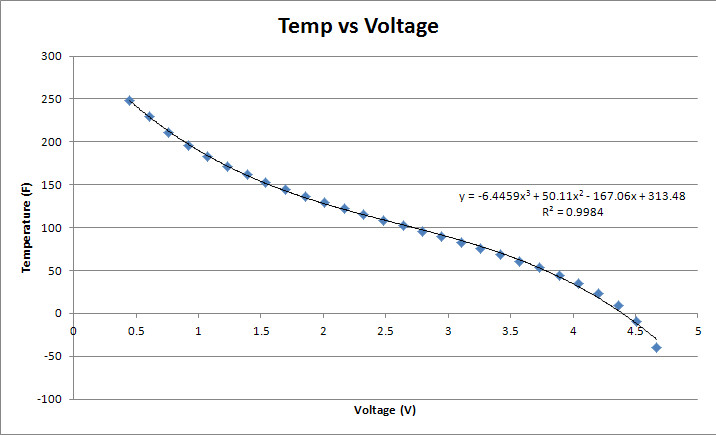 See that part in the middle from about 1.5V to 3.0V? That is the most linear part of that curve. It has the most resolution because a larger change in Voltage correlates to a smaller change in Temperature. I think what you are really getting confused over is the following. The ECU or any electronic device really, can't measure resistance directly. They can only read the voltage using a circuit with a known resistor then back-calculate the actual resistance. Look at the following Temp vs Resistance curve and how it looks as a Temp vs Voltage curve after using a pull-up resistor of 1000 ohms.  The bottom curve is how the ECU sees it. Again, the part in the middle has the most resolution. You could model the curve from the 1V to 4V region using a linear fit and it would be over 99% accurate.
_________________
MS41 Project Leader & Co-Developer (2012 - 2023)
MS41.3 https://sites.google.com/site/openms41/custom-code---ms41-3
MS41 ECU Portal https://sites.google.com/site/openms41/ms41-ecu-portal
Last edited by mrf582 on Fri Feb 21, 2014 12:31 pm, edited 1 time in total.
|
|
| Top |
|
|
|
Fearless
|
Post subject: Re: SPREADSHEET: GM IAT Posted: Wed Jun 06, 2012 12:49 pm |
|
|
| Experienced |
|
Joined: Thu Apr 19, 2012 3:44 am
Posts: 385
|
Well now, don't I both look and feel like an idiot! :-) This is my data, measured by me, generated with my code, and never, in 5 years of using it, visualised like this before! Degrees C vs. 10 bit ADC count. Yep, I apologise! Thank you for setting me straight, I appreciate it. You'd still have crappy accuracy at the end without lots of points, though. And it's still faster and easier to just grab a number and use it. But the point that I was arguing about was correct. Woops. Fred. 
_________________
The type of scooby that I most enjoy!
|
|
| Top |
|
|
|
mrf582
|
Post subject: Re: SPREADSHEET: GM IAT Posted: Wed Jun 06, 2012 1:12 pm |
|
|
| Senior Member |
Joined: Fri Feb 10, 2006 7:04 pm
Posts: 2661
Location: RIP
|
|
| Top |
|
|
Who is online |
Users browsing this forum: No registered users and 3 guests |
|
You cannot post new topics in this forum
You cannot reply to topics in this forum
You cannot edit your posts in this forum
You cannot delete your posts in this forum
You cannot post attachments in this forum
|
|


